

The philosophical challenge of separating factual inquiries from legal conclusions permeates American jurisprudence. The Seventh Amendment preserves the right of trial by jury in suits at common law. The determination of whether an issue constitutes a “question of fact” or a “matter of law” can dictate the entire trajectory of litigation. It determines whether a litigant is entitled to a jury trial, whether a judge may dispose of a case via summary judgment or directed verdict, and the standard of deference an appellate court must apply, ranging from highly deferential “clearly erroneous” or “substantial evidence” review for factual findings, to strict de novo review for matters of law. The Supreme Court is often called upon to play referee and allocate power to the judge or the jury. Generally, the Court entrusts juries with the protection of liberty and property against direct government punitive action,[1] while reserving for the judiciary the authority to draw the macroeconomic and constitutional lines that govern the broader American legal system.[2] In granting Rise Brewing’s petition for a writ of certiorari, the Court has once again positioned itself as a referee in this constantly shifting procedural boundary between judge and jury in litigation.
RiseandShine Corporation (doing business as Rise Brewing) launched its canned nitro-brewed coffee products in 2016. It secured federal trademark registrations for the word mark “RISE BREWING CO.”[3] and its associated design. To build its market presence and establish secondary meaning in the minds of consumers, Rise Brewing claims that it invested heavily in brand promotion, spending approximately $17.5 million in advertising its RISE drinks.[4] In March 2021, beverage conglomerate PepsiCo launched a fruit-flavored morning energy drink branded “MTN DEW RISE ENERGY.”[5] Following the launch, Rise Brewing alleged that PepsiCo’s product triggered consumer confusion.
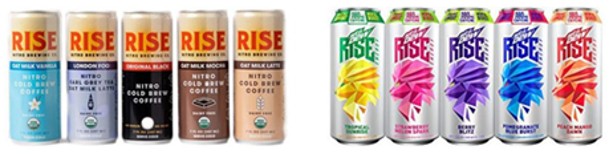
Rise Brewing’s products are to the left and PepsiCo’s are to the right. (Source: RiseandShine’s Petition for a Writ of Certiorari [6])
Under the Lanham Act (15 U.S.C. §§ 1114[7] and 1125[8]), a plaintiff asserting trademark infringement must prove two primary elements: (i) that the mark is valid and protectable, and (ii) that the defendant’s use of a similar mark in commerce is likely to cause consumer confusion. In traditional “forward confusion” trademark infringement, a junior user (typically a smaller or newer company) attempts to free-ride on the established reputation and goodwill of a senior user. The consumer is confused into believing that the junior user’s product was manufactured by the senior user. “Reverse confusion” occurs when the senior user is the smaller or newer company (like Rise Brewing) and the public erroneously assumes that the senior user’s products are affiliated with, or originate from, the junior user (typically a large and well-established company such as PepsiCo). As the Third Circuit noted “the doctrine of reverse confusion is designed to prevent the calamitous situation we have here — a larger, more powerful company usurping the business identity of a smaller senior user.”[9] The determination of a “likelihood of confusion” under the Lanham Act is a highly fact-intensive, multifactorial analysis. In the Second Circuit, this analysis is governed by the Polaroid factors.[10] Within the Polaroid framework, the “strength of the mark” is routinely considered a significant and dispositive factor. Strength of the mark is the conceptual distinctiveness of the plaintiff’s mark and its commercial tendency to identify the source of the goods. It includes both “inherent” strength and “acquired” strength.
A dispute over facts and law
The legal wrangling was brewed to a potent potion in 2021, when Rise Brewing filed a trademark infringement lawsuit against PepsiCo. Rise Brewing asserted reverse confusion, wherein PepsiCo’s massive market presence threatened to overwhelm Rise Brewing’s senior trademark identity. Rise Brewing secured a preliminary injunction from SDNY,[11] which was later vacated by the U.S. Court of Appeals for the Second Circuit.[12] The Second Circuit panel concluded that the district court had committed “legal error” in its evaluation of the mark’s strength. While agreeing that “RISE” is a suggestive mark, the appellate court ruled that it is at the “low end of the spectrum of suggestive marks.”[13] The court noted the “strong logical associations” between “rise” and morning coffee, finding this connection indicates weakness, rather than strength, for a suggestive mark.[14] The court deemed the mark inherently weak as a matter of law, identifying the notion that one is not fully awake until consuming coffee as a common cultural cliché.[15]
As part of its analysis, the Second Circuit scrutinized the prosecution history of Rise Brewing’s trademarks at the United States Patent and Trademark Office (USPTO). During the application process, the USPTO initially rejected RiseandShine’s application to register “RISE COFFEE CO.” before the company successfully registered “RISE BREWING CO.”[16] To overcome these rejections, Rise Brewing had argued that the “presence of multiple marks using the word ‘Rise’ indicated the mark’s weakness: ‘[M]any entities have used the word ‘Rise’ in relation to the Applicant’s goods, making it unlikely that consumers would give significant weight to this term in ascertaining the source of such goods.”[17] The appellate court used this admission against Rise Brewing, concluding that “[i]f there was room for Plaintiff’s use of ‘Rise’ in the already crowded coffee field, there would also be room for Defendant’s, especially on a product that is distinct from coffee.”[18] However, the court’s analysis appears to gloss over the nuance of a reverse confusion claim. The admissions made by RiseandShine in response to an office action are conceptually distinct from the threat posed by reverse confusion.
On remand, the district court granted summary judgment[19] in favor of PepsiCo, holding that the inherent weakness of the “RISE” mark strongly favored PepsiCo as a matter of law. On appeal, this was affirmed by the Second Circuit, with the appellate panel rejecting Rise Brewing’s argument that inherent strength is a question of fact.[20] Rise Brewing filed a petition for a writ of certiorari with the U.S. Supreme Court on March 19, 2025.[21] The central issue on appeal is whether trademark strength is a question of fact or a question of law in a likelihood-of-confusion analysis under the Lanham Act (15 U.S.C. § 1114). According to the petition for certiorari, twelve federal appellate circuits (including the First, Third, Fourth, Fifth, Seventh, Ninth, and Eleventh Circuits) consider trademark strength to be an issue of fact or a mixed question heavily dominated by facts. Courts in these circuits rely on the principle that likelihood of confusion is an inherently empirical question regarding market realities. The U.S. Solicitor General filed an amicus brief[22] arguing that inherent strength is a predominantly factual question that should ordinarily be resolved by a jury. On June 29, 2026, the Supreme Court officially granted certiorari to hear the case.
What recent Supreme Court jurisprudence says
The classification of trademark sub-factors as factual inquiries finds strong support in recent Supreme Court jurisprudence. In a unanimous opinion in Hana Financial,[23] the Supreme Court ruled that “tacking” (a doctrine allowing a trademark owner to alter a mark slightly over time while retaining the original priority date) is inherently a question of fact for the jury. The Court stated that “we have long recognized across a variety of doctrinal contexts that, when the relevant question is how an ordinary person or community would make an assessment, the jury is generally the decisionmaker that ought to provide the fact-intensive answer.”[24] Like in Hana Financial, inherent strength of a trademark relies intrinsically on the consuming public’s perception of the mark’s source-identifying power. While judges may classify marks as generic, descriptive, suggestive, arbitrary, or fanciful, such classifications derive their practical significance from how ordinary consumers understand the relationship between the mark and the goods it identifies.
Anchored in New York, the financial and trademark capital of the country, the Second Circuit frequently develops sophisticated legal doctrines. Alongside the Fifth and Ninth Circuits, the Second Circuit is historically one of the primary drivers of deep federal circuit splits.[25],[26] In business and financial law contexts, its specialized jurisprudence sometimes leaves it isolated. The Supreme Court receives approximately 7,000 petitions for a writ of certiorari each term and decides about 100 of these cases (roughly 1.4%).[27] Data from the Administrative Office of the U.S. Courts indicate that in FY2024, the 12 regional U.S. Courts of Appeals collectively issued 23,460 appellate opinions or orders in cases terminated on the merits, and 24,534 such opinions or orders in FY2023.[28] Yet, due to the immense economic stakes and national commercial implications of its rulings, petitions arising from the Second Circuit consistently command a significant, high-priority share of that 1.4% pipeline. For example, the Final Stat Pack for the 2025-26 Term indicates that of the 61 cases from the U.S. Courts of Appeals, the Second Circuit had nine cases, of which three were affirmed and six were reversed.[29]
Second Circuit cases taken up by SCOTUS are reversed or vacated about two-thirds of the time.[30] Empirical legal data from the Supreme Court Database (Spaeth) indicates that when SCOTUS steps in to resolve a heavily lopsided circuit split, the isolated outlier circuit is typically reversed.[31] For example, in Hana Financial, the Ninth Circuit was a lone outlier in holding that trademark “tacking” was a question of law, while the other circuits treated it as a question of fact for the jury. The Supreme Court unanimously reversed the outlier framework. Historically, the Court uses these scenarios as opportunities to restore commercial predictability across the country.[32]
A likely reversal
The Second Circuit’s approach to the judge-jury issue is guided by doctrinal consistency and efficient appellate management. Permitting appellate courts to characterize trademark strength as a legal question can promote predictability across commercial litigation and allow for efficient resolutions. The Supreme Court has a different approach and asks whether the Constitution and historical practice assign primary responsibility for resolving the issue to the judge or the jury. In the case of Rise Brewing, the Second Circuit found that inherent strength is a legal question, while the Supreme Court may find it to be a factual question.
If the Supreme Court were to affirm the Second Circuit, appellate panels will no longer have to give deference to a trial judge’s or jury’s assessment of how strong a brand is. Three appellate judges can look at a can of coffee, apply their own logic, and override the lower court entirely. If strength is a question of law, a judge can declare a mark weak before a trial ever takes place. Historical data and legal precedent both strongly indicate that the Supreme Court will likely reverse the Second Circuit and find that the inherent strength of a mark is to be treated as a matter of fact.
Such a ruling would reflect a deeper convergence of conservative legal principles: a strict textualist commitment to the traditional, fact-finding role of the civilian jury under the Seventh Amendment, coupled with a fundamental desire to protect established private property rights from being diluted by corporate market saturation.
All “Rise.” Court is now in session.
[1] SEC v. Jarkesy, 603 U.S. 109 (2024) (The Court held that the Seventh Amendment requires a jury trial for statutory claims that replicate common-law fraud); Hana Financial, Inc. v. Hana Bank, 574 U.S. 418 (2015) (Whether two trademarks may be tacked for purposes of determining priority is a question for the jury)
[2] Atlas Roofing Co. v. Occupational Safety and Health Review Comm’n, 430 U.S. 442 (1977) (Jury not required); Markman v. Westview Instruments, Inc., 517 U.S. 370 (1996) (Claim construction in patents is a matter of law); Google LLC v. Oracle America, Inc., 593 U.S. 1 (2021) (Determination of fair use is a mixed question of law and fact. Juries find subsidiary facts, judges determine fair use to maintain copyright boundaries); Connick v. Myers, 461 U.S. 138 (1983) (Speech on a ‘matter of public concern’ is a matter of law; prevents juries from unpredictably censoring protected speech or hindering government efficiency)
[3] https://trademarks.justia.com/870/42/rise-brewing-87042441.html
[4] RiseandShine Corp. v. PepsiCo, Inc., No. 24-1016, Petition for Writ of Certiorari at 4 (U.S. Mar. 19, 2025). Available at: https://www.supremecourt.gov/DocketPDF/24/24-1016/352514/20250319163025533_24-%20Petition.pdf
[5] https://www.fooddive.com/news/pepsico-launches-mtn-dew-energy-drink-amid-push-into-functional-offerings/596878/
[6] RiseandShine Corp. v. PepsiCo, Inc., No. 24-1016, Petition for Writ of Certiorari at 4 (U.S. Mar. 19, 2025).
[7] https://www.law.cornell.edu/uscode/text/15/1114
[8] https://www.law.cornell.edu/uscode/text/15/1125
[9] Commerce Nat’l Ins. Servs., Inc. v. Commerce Ins. Agency, Inc., 214 F.3d 432, 445 (3d Cir. 2000)
[10] Polaroid Corp. v. Polarad Electronics Corp., 287 F.2d 492 (2d Cir. 1961)
[11] RiseandShine Corp. v. PepsiCo, Inc., No. 21 Civ. 6324 (LGS), 2021 WL 5173862 (S.D.N.Y. Nov. 4, 2021)
[12] RiseandShine Corp. v. PepsiCo, Inc., 41 F.4th 112 (2d Cir. 2022)
[13] Id. at 121
[14] Id.
[15] Id. at 122
[16] Id. at 116
[17] Id. at 117
[18] Id.
[19] RiseandShine Corp. v. PepsiCo, Inc., No. 21-cv-3350, 2023 WL 4936000, at 8 (S.D.N.Y. Aug. 2, 2023)
[20] RiseandShine Corp. v. PepsiCo, Inc., Case No. 23-1176-cv, 2024 U.S. App. LEXIS 32182 (2d Cir. Dec. 19, 2024)
[21] RiseandShine Corp. v. PepsiCo, Inc., No. 24-1016, Petition for Writ of Certiorari at 14 (U.S. Mar. 19, 2025). Available at: https://www.supremecourt.gov/DocketPDF/24/24-1016/352514/20250319163025533_24-%20Petition.pdf
[22] Available at: https://www.supremecourt.gov/DocketPDF/24/24-1016/409398/20260520181120660_RiseandShine_CVSG%20v2.pdf
[23] Hana Financial, Inc. v. Hana Bank, 574 U.S. 418 (2015)
[24] Id. at 422
[25] See, Eric Hansford, Note, Measuring the Effects of Specialization with Circuit Split Resolutions, 63 Stan. L. Rev. 1145 (2011)
[26] See, Joseph A. Grundfest, Quantifying the Significance of Circuit Splits in Petitions for Certiorari: The Case of Securities Fraud Litigation (Stan. L. Sch. Working Paper, 2024), available at SSRN (documenting how the 2nd and 9th Circuits effectively dominate national commercial litigation, rendering their splits uniquely disruptive); see, also, https://www.scotusblog.com/2020/09/empirical-scotus-the-importance-of-state-court-cases-before-scotus/ (“Of the federal courts, the U.S. Court of Appeals for the 9th Circuit had the most cases reviewed by the Supreme Court with 10, which equated to 14% of the court’s docket.”)
[27] https://www.uscourts.gov/about-federal-courts/educational-resources/educational-activities/us-courts-appeals-and-their-impact-your-life/last-word-courts-appeals-cases-you-should-know
[28] See, https://www.congress.gov/crs-product/R48846#_Ref155765395
[29] See, Final Stat Pack for the 2025-26 Term (Available at https://cdn.sanity.io/files/pito4za5/production/563200520fdde75291c69f3eaeeee8f55aaaf27c.pdf)
[30] See, SCOTUS Case Reversal Rates (2007 – Present), Ballotpedia (reporting a macro Supreme Court reversal rate of 67%, for the Second Circuit); see, also, Martin Flumenbaum & Brad S. Karp, The Second Circuit in the Supreme Court, Paul, Weiss, Rifkind, Wharton & Garrison LLP (Sept. 2024), Paul, Weiss Insights.
[31] See, Eric Hansford, Note, Measuring the Effects of Specialization with Circuit Split Resolutions, 63 Stan. L. Rev. 1145 (2011) (pioneering the “circuit split resolution” data model to track which circuit doctrines the Supreme Court adopts or rejects when resolving intercircuit conflicts, illustrating that the direct reversal of an isolated lower court decision often serves as a structural affirmation of the competing circuit consensus)
[32] See, Eric Hansford, Measuring the Effects of Specialization with Circuit Split Resolutions, 63 Stan. L. Rev. 1145 (demonstrating that when resolving deep conflicts, the Supreme Court overwhelmingly favors circuit consensus, resulting in a reversal rate exceeding 85% for lone outlier circuits); see, also, quantitative data from the Supreme Court Database (Spaeth) (noting that the Court’s intervention in lopsided splits, such as 9-1 or 12-1 alignments, is driven by a structural mandate for uniformity, overwhelmingly resulting in the summary or merit reversal of the minority jurisdiction)