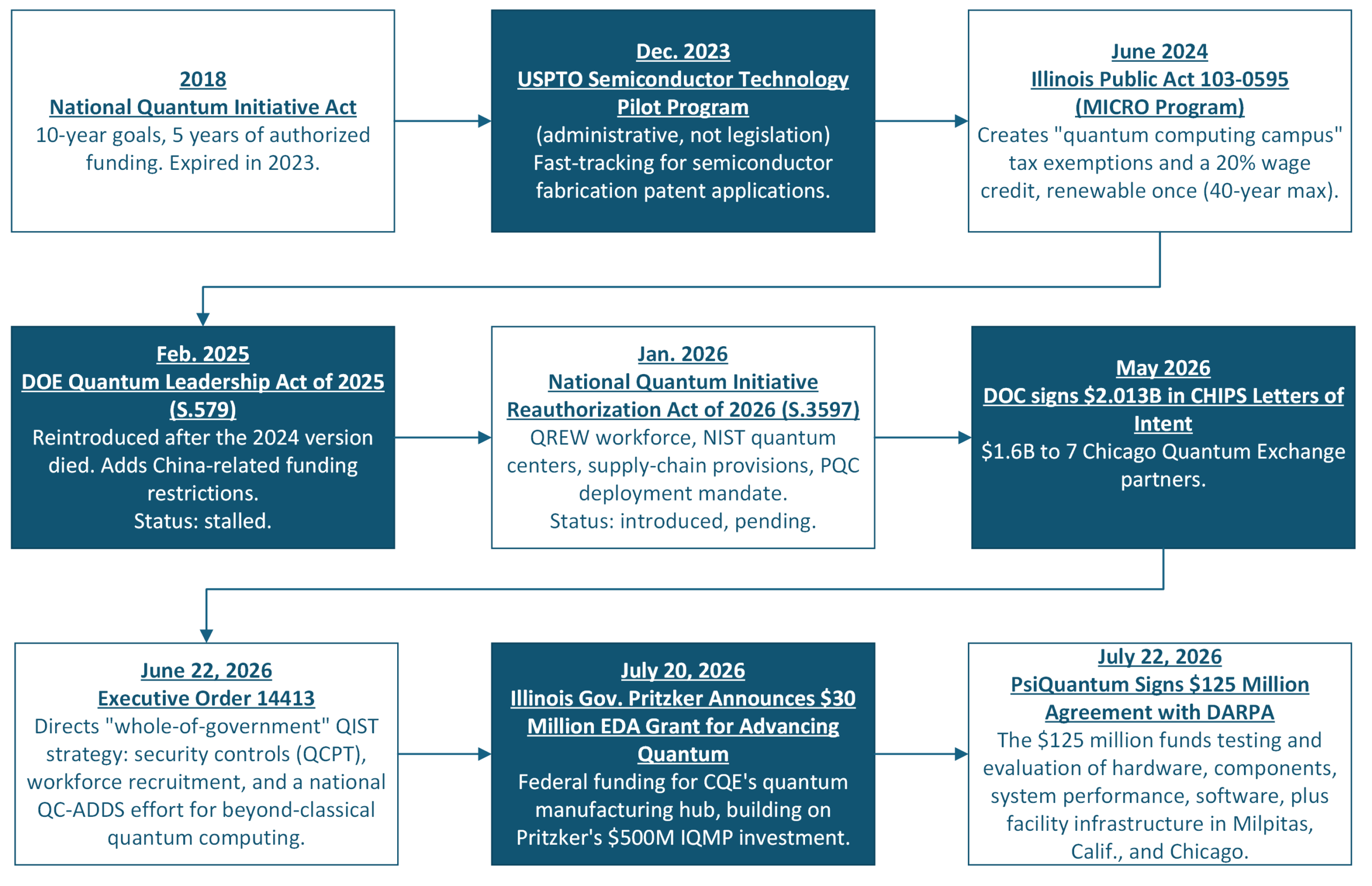
Building the Sandbox: Regulatory and Regional Foundations
In 2018, Congress passed the National Quantum Initiative Act (now expired), kick-starting America’s push in quantum computing with government funding. Then in late 2023, the United States Patent and Trademark Office (USPTO) anticipated the inevitable convergence of traditional semiconductor manufacturing and advanced quantum physics by instituting the Semiconductor Technology Pilot Program.[4] By waiving petition fees and fast-tracking applications corresponding to CPC codes H10 and H01L, the USPTO gave zealous innovators a runway to secure baseline chip fabrication IP before the market became inundated with IP filings.[5]
Simultaneously, regional legislative bodies capitalized on this momentum to position the Midwest as the ultimate destination for deep-tech commercialization. Illinois passed Public Act 103-0595, formally establishing “quantum computing campuses” and offering unprecedented 20-year tax exemptions and operational credits.[6] This statutory environment laid the financial groundwork for the Illinois Quantum and Microelectronics Park (IQMP) and anchor tenants like PsiQuantum. It also set the stage for the Chicago Quantum Exchange’s coalition to secure the massive federal manufacturing investments realized in 2026.[7],[8]
Raising the Guardrails: Geopolitical and Supply Chain Protections
As physical infrastructure funding began to materialize, federal lawmakers shifted their priorities from general research support to domestic IP expansion. Bipartisan efforts behind the proposal of the Department of Energy Quantum Leadership Act of 2025 and the subsequent National Quantum Initiative Reauthorization Act of 2026 indicate a desire to implement aggressive national security guardrails into the funding apparatus.[9],[10] Crucially, these pieces of proposed legislation seek to bar institutions from receiving federal quantum funding if they maintain contracts or active relationships with specified foreign entities of concern.[11] However, while the National Quantum Initiative Reauthorization Act of 2026 remains in committee, the similarities to President Trump’s Executive Order (EO) 14413[12] (titled “Ushering in the Next Frontier of Quantum Innovation”) suggest the executive branch grew tired of waiting on its legislative counterpart.
These legislative instruments allocated over $500 million combined toward stabilizing and securing American quantum supply chains, targeting specialized hardware dependencies.[13],[14],[15] Additionally, the reauthorization hopes to mandate the accelerated, voluntary deployment of post-quantum cryptography (PQC) across vulnerable enterprise and risk-management sectors.[16]
The Legacy Paradigm: Moving Away from Cost Deferral
When true market integration was projected to be over a decade away, we suggested emerging entities would heavily utilize provisional patent filings and the international Patent Cooperation Treaty (PCT) as deferral strategies.[17] However, with the Department of Commerce officially funding full-scale foundries, merely defraying costs is now a less appealing approach.[18] The pendulum has now swung the other way, and, in many cases, obtaining IP at an accelerated pace will now ensnare potential infringers as they begin building actual devices. The same goes for trade secrets; where corporations may have historically decided to keep their IP under lock and key, it will be advantageous to start to procure patents.
Strategic Predictions for the Evolving Quantum IP Market
As the industry accelerates from research prototypes to large-scale commercial foundries (like IBM’s Anderon facility), we predict the quantum IP market will undergo three fundamental transformations over the next 24 to 36 months.
1. The Dominance of Fabrication and Process Patents over Pure Software
Historically, quantum patents have been based around algorithms. Now, the true commercial battleground will pivot decisively toward physical manufacturing processes, material compositions, and tooling instrumentation. Generally speaking, method of manufacture and apparatus claims have higher detectability (i.e., are easier to identify and prove infringement), are less susceptible to patentability attacks (e.g., section 101 issues), and may be harder to design around.
Now with multi-billion-dollar foundries ramping up advanced wafer production, the most enforceable and valuable patent assets will cover physical devices (e.g., cryogenic shielding interfaces, laser-alignment optics, and defect-mitigation structures used for superconducting qubits). Crucially, these hardware inventions circumvent the complex subject-matter eligibility hurdles of Alice, making them highly predictable, highly defensible, and uniquely attractive to institutional investors.
2. The Surge of “Foundry-Client” Joint Ownership and Trade Secret Disputes
IBM’s Anderon foundry and the expanding infrastructure at the IQMP will act as shared hubs where a dense concentration of competing startups, academic institutions, and enterprise tech firms will fabricate and test proprietary architectures using identical physical R&D machinery. This centralized layout will create friction regarding joint-development agreements (JDAs) and patent inventorship/ownership. When a startup optimizes a qubit coherence rate using a proprietary technique that was designed through experiments leveraging a foundry’s proprietary custom manufacturing toolkit, who legally owns the resulting process optimization? We recommend that companies start locking down their IP before sharing know-how with everyone in the foundry, including making sure workflows for reasonably and reliably identifying, documenting, and protecting IP are up to date.
3. The Forced Emergence of Early “Quantum Patent Pools”
Because federal funding mandates the creation of an uninterrupted, fully domestic quantum supply chain, no singular market participant will be permitted to completely monopolize vital systemic infrastructure components. As overlapping proprietary “patent thickets” naturally begin to choke commercial scaling and cross-industry deployment, the federal government and industry players may consider (or be forced to consider) implementing the sector’s first formal Quantum Patent Pools and/or may begin cross-licensing efforts in earnest by the late 2020s, closely mirroring the historical IP evolution observed in the early telecommunications and semiconductor industries.
Conclusion
The transition of quantum computing from science fiction to physical fabrication is happening as we speak. Armed with billions in federal CHIPS incentives and robust regional infrastructure, the race to design and build large-scale systems is transitioning to the factory floor. For deep-tech innovators and corporate investors alike, a sophisticated, hardware-centric IP strategy should no longer be viewed as a long-term luxury—it is a baseline requirement for commercial survival.
[1] Chicago Quantum Exchange, Chicago Quantum Exchange Corporate Partners Secure Dominant Share of Historic $2 Billion Federal Quantum Funding Portfolio, CQE News (May 21, 2026), https://chicagoquantum.org/news/chicago-quantum-exchange-corporate-partners-secure-dominant-share-historic-2-billion-federal.
[2] Press Release, Off. of Gov. JB Pritzker, Governor Pritzker Announces $30 Million EDA Grant for Advancing Quantum, Gov. Pritzker Newsroom (July 20, 2026), https://gov-pritzker-newsroom.prezly.com/governor-pritzker-announces-30-million-eda-grant-for-advancing-quantum.
[3] Press Release, PsiQuantum Signs $125 Million Agreement with DARPA, PSIQUANTUM (July 22, 2026), https://www.psiquantum.com/news-import/psiquantum-signs-125-million-agreement-with-darpa; See our previous article discussing PsiQuantum’s other funding from DARPA here: https://www.mbhb.com/intelligence/snippets/senators-show-foresight-in-latest-quantum-push/.
[4] Aaron V. Gin, USPTO Kicks Off Semiconductor Technology Pilot Program to Expedite Semiconductor Manufacturing Applications, MBHB: Snippets (Nov. 30, 2023), https://www.mbhb.com/intelligence/snippets/uspto-kicks-off-semiconductor-technology-pilot-program-to-expedite-semiconductor-manufacturing-applications/.
[5] Id.
[6] Andrew H. Velzen, Illinois Passes Act Further Incentivizing Quantum Industry, MBHB: Snippets (June 28, 2024), https://www.mbhb.com/intelligence/snippets/illinois-passes-act-further-incentivizing-quantum-industry/.
[7] Chicago Quantum Exchange, Chicago Quantum Exchange Corporate Partners Secure Dominant Share of Historic $2 Billion Federal Quantum Funding Portfolio, CQE News (May 21, 2026), https://chicagoquantum.org/news/chicago-quantum-exchange-corporate-partners-secure-dominant-share-historic-2-billion-federal.
[8] Andrew H. Velzen, Illinois Passes Act Further Incentivizing Quantum Industry, MBHB: Snippets (June 28, 2024), https://www.mbhb.com/intelligence/snippets/illinois-passes-act-further-incentivizing-quantum-industry/.
[9] Andrew H. Velzen & Walter DeGroft, Senators Push for U.S. Leadership on Quantum, MBHB Snippets (July 9, 2025), https://www.mbhb.com/intelligence/snippets/senators-push-for-u-s-leadership-on-quantum/.
[10] Andrew H. Velzen & Walter DeGroft, Senators Show Foresight in Latest Quantum Push, MBHB: Snippets (Jan. 21, 2026), https://www.mbhb.com/intelligence/snippets/senators-show-foresight-in-latest-quantum-push/.
[11] Andrew H. Velzen & Walter DeGroft, Senators Push for U.S. Leadership on Quantum, MBHB Snippets (July 9, 2025), https://www.mbhb.com/intelligence/snippets/senators-push-for-u-s-leadership-on-quantum/.
[12] Exec. Order No. 14,413, Ushering in the Next Frontier of Quantum Innovation (June 22, 2026), https://www.whitehouse.gov/presidential-actions/2026/06/ushering-in-the-next-frontier-of-quantum-innovation/.
[13] Andrew H. Velzen, Illinois Passes Act Further Incentivizing Quantum Industry, MBHB: Snippets (June 28, 2024), https://www.mbhb.com/intelligence/snippets/illinois-passes-act-further-incentivizing-quantum-industry/.
[14] Andrew H. Velzen & Walter DeGroft, Senators Push for U.S. Leadership on Quantum, MBHB Snippets (July 9, 2025),
https://www.mbhb.com/intelligence/snippets/senators-push-for-u-s-leadership-on-quantum/.
[15] Andrew H. Velzen & Walter DeGroft, Senators Show Foresight in Latest Quantum Push, MBHB: Snippets (Jan. 21, 2026), https://www.mbhb.com/intelligence/snippets/senators-show-foresight-in-latest-quantum-push/.
[16] Id.
[17] Id
[18] Chicago Quantum Exchange, Chicago Quantum Exchange Corporate Partners Secure Dominant Share of Historic $2 Billion Federal Quantum Funding Portfolio, CQE News (May 21, 2026), https://chicagoquantum.org/news/chicago-quantum-exchange-corporate-partners-secure-dominant-share-historic-2-billion-federal